

Play and learn languages
Emma and her friends from the visual novel Interview with Emma

Interactive language-learning novel

Interview with Emma: learn languages by living a story

You play as Emma, a first-year journalism student. Every line is voiced. Tap a word you are learning to see its translation, tap a button to translate the whole line. And at the end of every scene a quiz is waiting for you. Level A2–B2.

The demo has English and Spanish. Coming by release: French, German, Portuguese, Italian, Turkish and more.

Windows, macOS, Linux and Steam Deck. A mobile version will come later. Add the game to your Steam wishlist so you don't miss the release.

This page is open inside a social app. To add the game to your Steam wishlist or play the demo in your browser, open the page in a browser: tap ⋯ or ⋮ at the top and choose Open in browser.

Watch the trailer

If the video doesn't start, watch it on YouTube.

How you learn a language in Interview with Emma

Interview with Emma is a visual novel: you read and listen to the story of Emma and her friends at university, and every scene doubles as a lesson. Here is how it works.

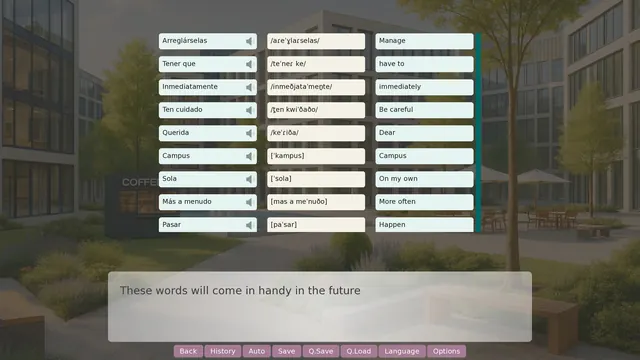
Vocabulary before a scene: words with transcription, audio and translation

New words before every scene

Before a scene you meet the key words: see the transcription and hear the pronunciation. Then you run into them in a live dialogue and remember them together with the situation, not with a flashcard.

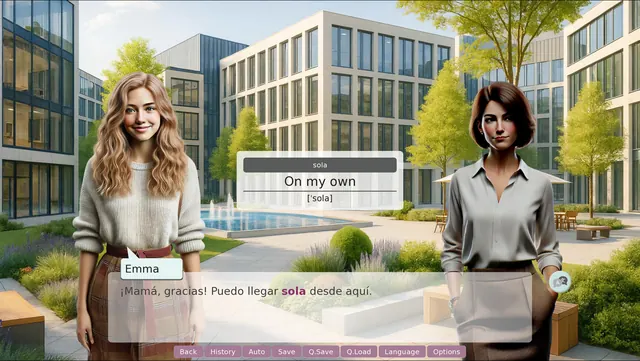
Tapping the Spanish word sola shows its translation and transcription

The scene: listen, tap, translate

The dialogue is in the language you are learning, and every line is voiced. The words you are learning are highlighted: tap a word to hear it and see its translation and transcription. Can't make sense of a whole phrase? One button translates the entire line. No need to open a dictionary and lose the thread of the story.

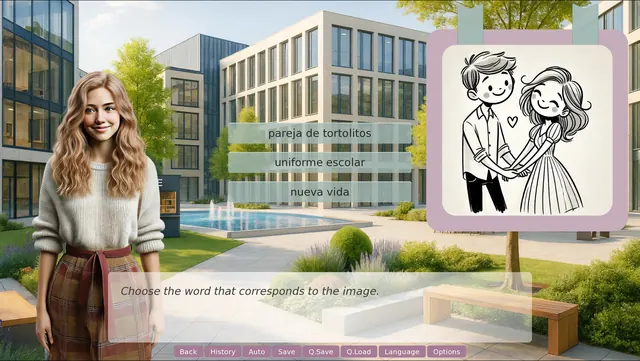
Quiz: choose the phrase that matches the picture

Quizzes with variety

After every scene a quiz is waiting, and the tasks are varied: choose a word, fill in the blank, write what you heard, match a word to a picture. You see the result right away.

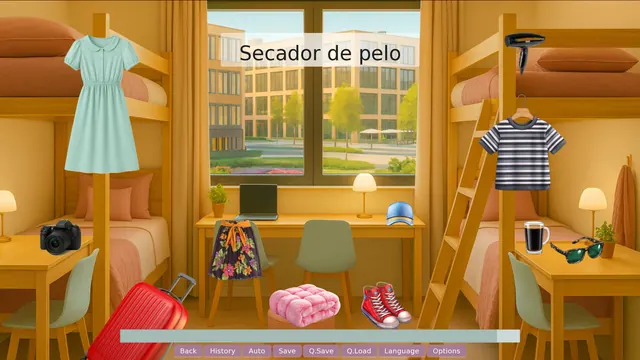
Mini-game: find the hair dryer, secador de pelo, in Emma's room

Karaoke and mini-games

Sing karaoke with bilingual subtitles, look for objects in Emma's room, peek into her phone messages. These are fun breaks between scenes: you play, and the words stick by themselves.

Why a story works better than short video lessons

Thirty-second language clips are fun, but almost nothing stays in your memory: the phrase flashes by and the next clip has already started. A story works the other way around.

How it compares with other ways to learn a language

Every format has its strength. Here is an honest comparison.

Short video lessonsApps with short exercisesInterview with Emma
ContextVery short contextSeparate sentences unrelated to each otherEvery word is part of a story with characters
PaceThe video moves on without waiting for youThe lesson goes step by step: often you can't go back and redo a taskPause on any line, replay a line or the whole scene, translation on tap
PracticeYou only watch and listen, no tasksYou do tasks, but listen littleYou listen and do tasks: a quiz after every scene with different task types
ListeningA few seconds per clipSeparate voiced phrasesEvery line is voiced, whole conversations
Word repetitionThe phrase flashes by and is goneWords repeat, but outside a shared storyA word appears in the dictionary, in the dialogue and in the quiz, all inside the story
Best forQuick inspirationA daily habitDeep reading and listening practice, A2–B2

On a phone you can scroll the table sideways.

Who it's for

For people learning English or Spanish (French, German, Portuguese, Italian, Turkish and more are coming by release). Level A2–B2 fits best: you already know the basics and want to understand real speech. If you are just starting, the button that translates a whole line will help.

And for those who have already tried flashcards and short lessons and finally want to read and listen to something longer, at their own pace.

Why I'm making this game

Hi, I'm Lina. In early 2025 I moved to Spain, and ever since I have been learning Spanish and English at the same time. I noticed that I remember words best when they are part of a story I care about, not a list to cram.

I looked for games where you can practice a language, but in them an unfamiliar word stays unfamiliar: by the time you get the translator out, the action has moved on. So you can only practice what you already know.

That is how Interview with Emma was born. I have been making it for more than two years, alone, in my free time: writing scenes, preparing dictionaries and quizzes, checking every line. It is the app I wanted for myself.

Want to support the project? Add the game to your Steam wishlist and follow the channels. It really helps.
Questions and answers

What is Interview with Emma?

An interactive visual novel for learning languages. You follow the story of Emma, a first-year student, and learn a language along the way: you listen to voiced dialogues, tap the words you are learning, take quizzes, sing karaoke and play mini-games.

Which languages can I learn?

The free demo has English and Spanish. French, German, Portuguese, Italian, Turkish and more will be added by release. The interface and translations are available in English, Spanish and Russian.

What level do I need?

It works best at A2–B2. Beginners can play too: the button that translates a whole line and the word translations help with every phrase.

Is it free?

There is a free demo on Steam and itch.io. The full version on Steam is planned for early 2027.

What devices does it run on?

Windows, macOS and Linux through Steam, including Steam Deck, and in the browser on itch.io. A mobile version will come later.

Is it a replacement for Duolingo?

It is a different approach. Apps like Duolingo are built on short daily exercises. Interview with Emma is a story you read and listen to at your own pace: you can spend as long as you need on every line, then check yourself with a quiz after the scene. Many people combine them: an app for the daily habit, the novel for long, deep practice.

Can you really learn a language through a game?

A visual novel gives you lots of reading and listening in context, and that is how we pick up most of our vocabulary. The game adds what an ordinary story lacks: translation on request, a dictionary with transcription and audio, and quizzes that check what you have learned.

Play & Learn: a series of stories for learning languages

Interview with Emma is the first story of the Play & Learn series. Each game is a separate story with its own characters, united by one idea: learn a language by living something interesting in it.

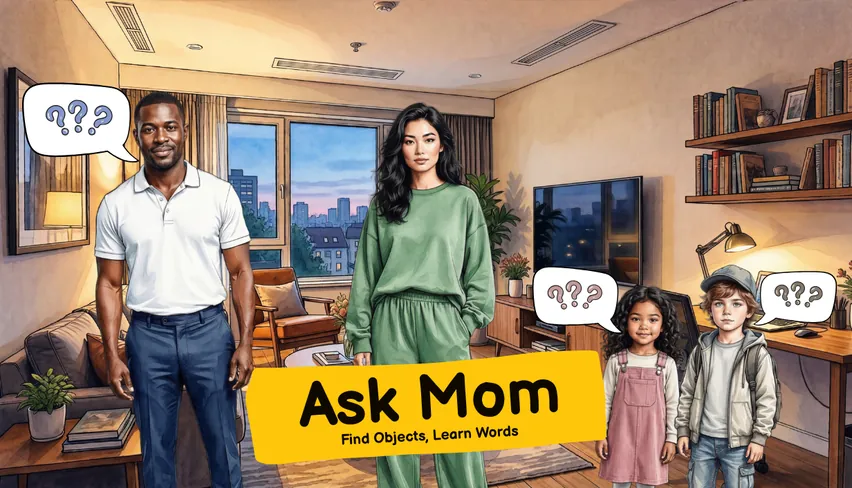
Ask Mom: find objects, learn words

Ask Mom

Find objects around the house and learn their names. A light game for building vocabulary, coming soon to Steam.

Wishlist on Steam

Secret of the Royal School of Magic

A magical story set in a school of magic, which you can use to learn languages. Demo on itch.io.

Demo on itch.io